
C:N ratios
Learn about the importance of C:N ratios, mineralisation and immobilisation.

Course content
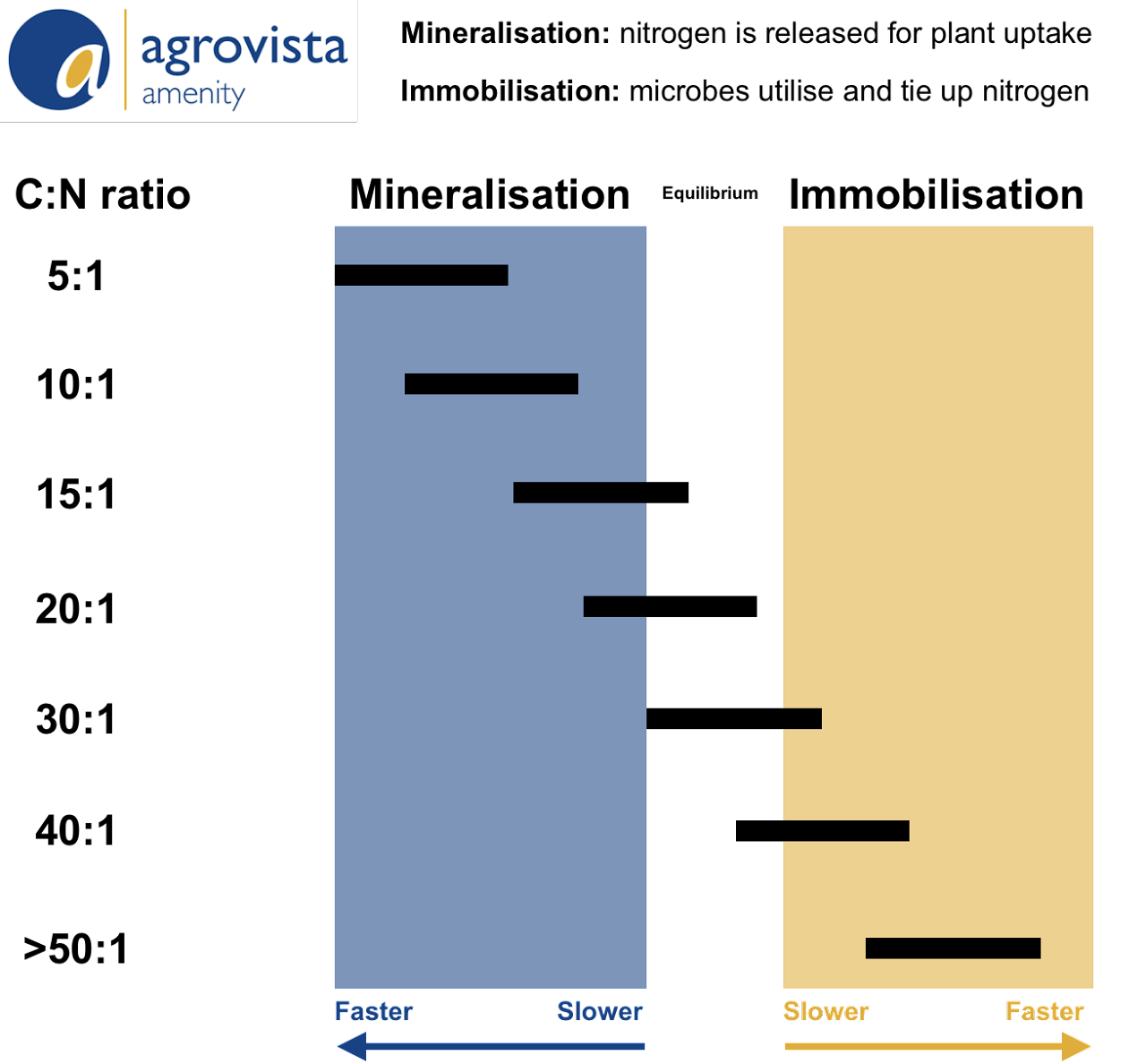 Fairly equal rates of mineralisation and immobilisation will occur when decomposing residues are between C:N 20:1 to 30:1Net mineralisation occurs at C:N ratio less than 20:1Net immobilisation occurs at C:N ratios greater than 30:1In amenity turf settings most soils containing well composted organic matter have a C:N ratio of around 10-14:1
C:N - Carbon:Nitrogen Ratios
The carbon to nitrogen ratio in plants is crucial for routine cellular activities. Carbon compounds such as carbohydrates, sucrose and glucose, provide carbon energy for nitrogen assimilation and the resultant creation of amino acids. These amino acids are the building blocks of proteins which plants use to build compounds and in particular enzymes, which are essential for almost all cellular activity and plant function.
Microorganisms burn carbon as fuel to form new cell material using their stored nitrogen. Those organisms then excrete excess nitrogen as ammonium.
Organic matter is decomposed in soil by microorganisms that use the carbon content as a source of energy to fuel their bodies. This process releases carbon and nitrogen into the soil ecosystem as compounds. Carbon in the form of carbohydrates, and nitrogen in the plant available forms ammonium and nitrate. This process is the foundation of the soil ecosystem.
The rate at which this process takes place is influenced by the ratio of carbon to nitrogen present in the organic substances and the surrounding soil.
A ratio of around 12 parts carbon to 1 part nitrogen (12:1) in the soil would normally provide a good balance which ensures both nutrient availability through mineralisation and decomposition of organic matter to maintain a healthy soil ecosystem.
When the C:N ratio is high soil microbes need to find another source of nitrogen to digest the organic carbon resulting in a reduction in nutrient availability due to immobilisation.
Benefits of applying carbon sources to sports turf surfaces
A. Carbon to nitrogen ratios in constructed turfgrass soils are limited for two main reasons:
- High filtration rate sand dominated rootzones which inherently contain low amounts of organic matter.
- Limited production of root exudates due to reduced photosynthesis. This is because of a limited leaf surface area resulting from short heights of cut.
B. Carbon inputs balance the C:N Ratio - facilitating efficient soil ecosystem function resulting in:
- Optimum organic matter decomposition leading to enhanced nutrient cycling and uptake.
- Enhanced beneficial plant microbial interactions.
The importance of balance
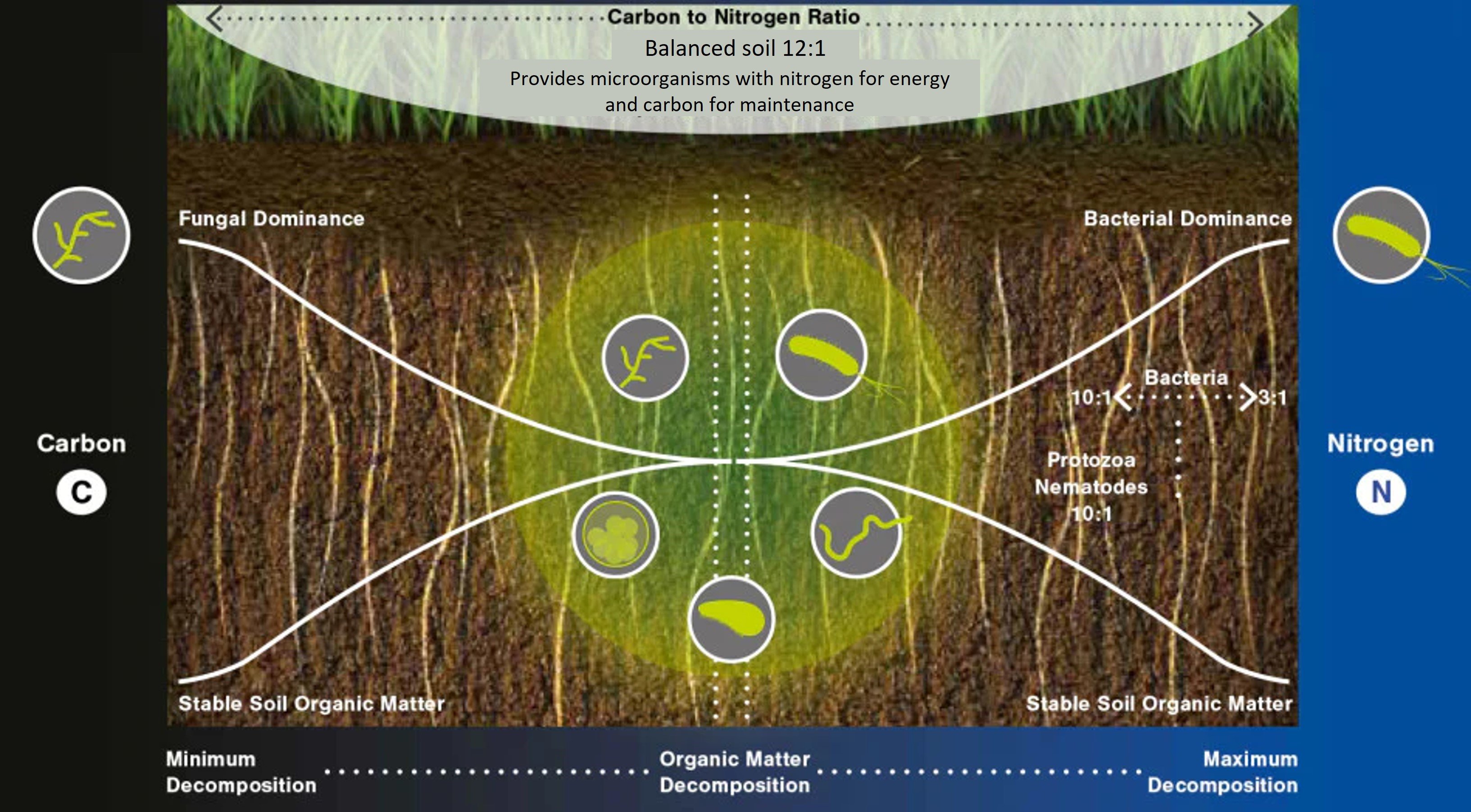
If the C:N ratio is too low then decomposition of organic matter can take place too quickly resulting in a soil which is bacterially dominated and reducing the available menu of balanced organic matter for other soil organisms. This has the effect of reducing efficient soil ecosystem function and limits the plant associated benefits of a flourishing system.
If the C:N ratio is too high, decomposition of organic matter is too slow, nitrogen becomes limited and the balance moves away from bacteria. This can lead to organic matter accumulation, and a further limiting of efficient soil ecosystem function.
High carbon = slower decomposition e.g. lignin, more easily digested by fungi
Low carbon = quicker decomposition e.g. cellulose, more easily digested by bacteria
In the diagram above the relative dominance of fungi or bacteria is represented by the inverse bell curve (upper white line) with the pace of organic matter decomposition represented by the bell curve (lower white line).
The optimum ratio in soils is around 12:1 At this point mineralisation of plant nutrition and, rate of stable organic matter generation is at the optimum.
Mineralisation
Nitrogen is released for plant uptake
For nitrogen to be used for growth by grass it must first be fixed (or converted) to ammonium or nitrate ions. Fungi and bacteria that degrade organic matter and release already fixed nitrogen are of real interest and indeed they have a fundamental role to play in all aspects of nitrogen availability. The process that converts organic nitrogen to ammonium is called mineralisation.
One of the primary conditions that affects nitrogen mineralisation of organic matter to ammonium is the amount of organic nitrogen, available in the organic matter, that is available to be mineralised. Temperature range, adequate oxygen, moisture content and the ratio of C:N (carbon to nitrogen), also play a critical role.
Since the microorganisms living in the soil need both carbon and nitrogen, net mineralisation is said to occur when the C:N ratio is less than 20:1. For every two parts of carbon, there should be one-part nitrogen. If there is too much carbon, immobilisation can occur.
Immobilisation
Microbes utilise and tie up nitrogen
Immobilisation is the process that converts inorganic nitrogen to organic nitrogen. It is the reverse of mineralisation. It occurs when decomposing organic matter has a high C:N ratio. Microorganisms that also need nitrogen to live, scavenge the soil for their nitrogen requirements when plant residues contain inadequate amounts of usable nitrogen. As the inorganic ammonium and nitrate is incorporated into the cells of these living microorganisms, the total nitrogen level in the soil is reduced. Immobilisation can ultimately result in nitrogen deficiencies.
As a result, nitrogen deficiency caused by immobilisation grass can develop a yellow colour. This is the reason why organic materials with a high C:N ratio, such as grass clippings, should be composted before they are incorporated into the soil. This allows time for the soil microorganisms to decompose the materials and begin to release nitrogen and other nutrients back into the soil (mineralisation).