
Managing moss
This course has been designed to help you better understand the management of moss

Course content
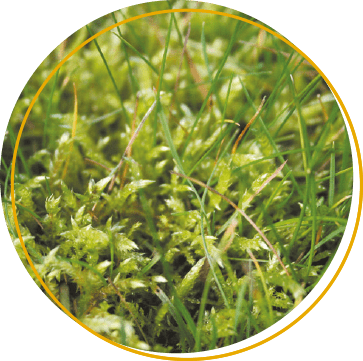 Picture:- Hypnum jutlandicum (pleuro carpous moss in amongst fescue grasses).
Moss
Moss, like every living organism, requires moisture. The difference between mosses and other plants is that they do not require a root system for survival, though some produce a structure called rhizoides.
Whilst many take nutrients from the substrate directly beneath them, a lot of mosses can also survive in areas where moisture, and nutrients, pass over the leaf. They are also an organism that, in comparison to grass species, can tolerate shade and poor drainage.
These are special qualities that help us understand why they can be found on most surfaces, even hard surfaces such as roofs and pathways. The high levels of moisture, mild temperatures and a competitive growth habit over the winter period have therefore been a major contributing factor to the amount of moss we have witnessed in the early spring.
Mosses are plants that do not have a vascular system. They are part of the order called Bryophytes. As well as mosses, Bryophytes also contain the groups Hornworts and Liverworts.
After flowering plants and ferns, mosses are the most diverse form of plants, with over 10,000 species in more than 700 genera; nearly twice as many genera as all the mammals on Earth.
In addition to not having a vascular system, they also have no woody parts. The lack of a vascular system makes them susceptible to desiccation and, therefore, they tend to be found in damp, moist and even aquatic habitats, although not exclusively, and some species have remarkable adaptations to very dry habitats.
Moss can be a problem within turf, and the appearance of hard surfaces, such as patios or tennis courts, can be compromised by mosses. These two areas need to be considered separately, as they require different solutions.
Botanically moss species are divided into two categories:
- Pleurocarpous: mosses where the archegonia (female sex organ) are situated along short lateral branches. These species of moss exhibit a spreading growth habit often forming carpets. The growth extends from a single point at the tip of a branch (monopodial) which then branches. Very often this branching is multi-divided (pinnate) and may have a feathery appearance.
- Acrocarpous: denotes mosses where the archegonia are situated at the tips of stems or branches. Generally, acrocarpous mosses do not branch and spread, rather they grow in upright tufts.
Colloquially within the sports turf industry, mosses are often categorised into three descriptive groups, as follows:
- Cushion forming: Tiny upright clusters of growth, those associated with closely mown and scalped turf situations
- Trailing: Feathered looking types of moss, those associated with poor drainage and shade problems
- Upright: Larger tuft type mosses, those associated with drier acidic soils
Timing and tips on moss control
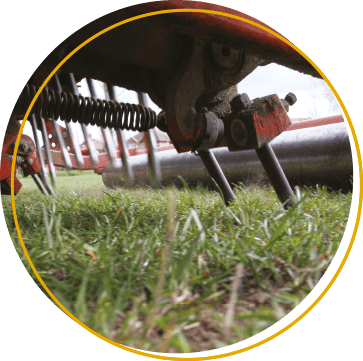
This situation can be alleviated with aeration, generally undertaken in the spring or autumn when sufficient warmth and moisture are available to enable the grass to repair. A typical renovation will involve applying an authorised moss control product either as a granular or a liquid. Ensure that the moss is damp, not wet through, but able to absorb the substance being applied.
Surfaces affected
Both natural and synthetic surfaces can be affected by moss when the favoured conditions are prevalent. Playing characteristics are affected in that moss can affect ball bounce/roll on fine turf situations. Moss may cause surface traction problems for players on artificial surfaces, which may result in injuries.
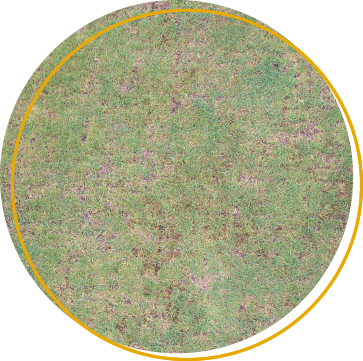
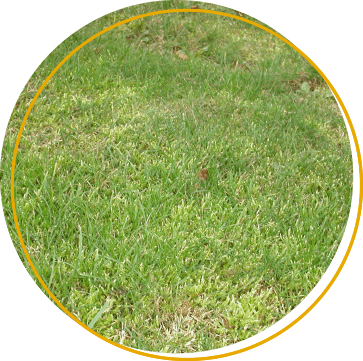
Moss on a fine turf putting surface
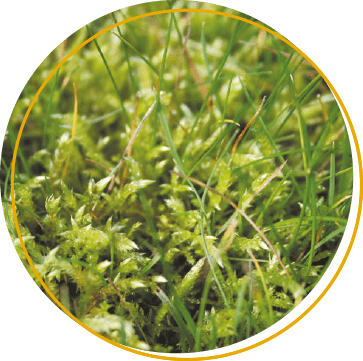
Bryum argenteum (acrocarpous moss in amongst annual meadow grass)
How do we control moss growth in a turf environment?
The traditional method of moss control typically utilised the use of lawn sand and cultural practices. Moss is classified as a plant therefore; under regulation it should only be controlled by the use of an plant protection product which has been authorised and assigned a MAPP number by the Chemicals Regulation Division branch of the Health and Safety Executive.
In a professional setting, treating the area with an authorised product containing iron sulphate is commonly undertaken., This causes the moss to die off, prior to physical removably raking. This would have the added benefit of 'greening up' the sward without causing excess growth. The growth habit of an acrocarpous moss is a contributing factor to why they are more difficult to control in general than their pleurocarpous counterparts. Essentially with a tufted, more vertical growth habit, scarification or verticutting often does not have the desired effect.
Many golf and bowls greenkeepers will be familiar with the invasion of a moss known commonly as 'silver thread moss' (Bryum argenteum). This sub-species is of particular nuisance due to its rapid colonisation of weak areas and an ability to withstand control from iron sulphate.
As moss is an advantageous species, the important thing is to try and ensure a competitive growth habit by the individual grass plants. Ground coverage, especially heading into the winter, is therefore essential.
What else can be done to reduce the risk of moss invasion/establishment?
Ensure adequate irrigation without over-watering. Many sports complexes around the country utilise an automatic irrigation system. In periods of stress, it would be advisable to water thoroughly, but to requirement. Over-watering can lead to other unwanted problems.
Find a balance in mowing height. Particularly in golf and bowls, mowing height plays a significant part in how the ball reacts with the surface. Ensuring you can find a balanced mowing height to allow good coverage without affecting playing quality is important in all sports in terms of moss reduction.
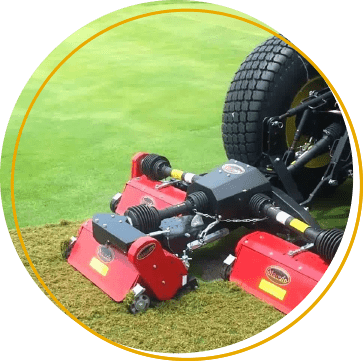
- Reduce thatch - The utilisation of controlled frequency verticutting and deep scarification during periods of good recovery will reduce the organic content within the thatch layer. Reducing this moisture holding ability within the O horizon of the soil is very important in moss control.
- Aeration - As with anything in a sports surface, ensuring the best aeration will help provide a competitive grass sward. As mosses prefer compacted, moist soils, reducing the compaction and increasing drainage ability is a great tool in reducing the efficacy of moss invasion.
- Removal of surrounding causes of shade - In areas that are prone to moss, look around the area and whether anything can be done to reduce the shade/increase direct light levels (e.g. removal of tree limbs etc). As mentioned previously, moss is highly competitive in shade over grass.
- Overseeding - Overseeding in the autumn is recommended due to a more reliable amount of moisture and mild temperatures promoting early germination and establishment. Ensuring good establishment could be key in increasing coverage as you head into winter, particularly in known bare areas.
- A balanced fertiliser programme - Obviously, with all of these control methods it's important to strike a balance between the needs of your customers/visitors and the effective control of moss. Following this sort of integrated approach in general should provide an excellent basis for the production of quality surfaces. Therefore, the effective control of moss could/should occur as a by-product of solid greenkeeping techniques.
Lesson notes
- Moss -study the different type of moss in turf
- When - understand when and where moss occurs
- Control - study how to control moss in turf