
Practical Solutions
Take a look into chemical, biological and physical aspects of soil for optimum turf health

Course content
Introduction
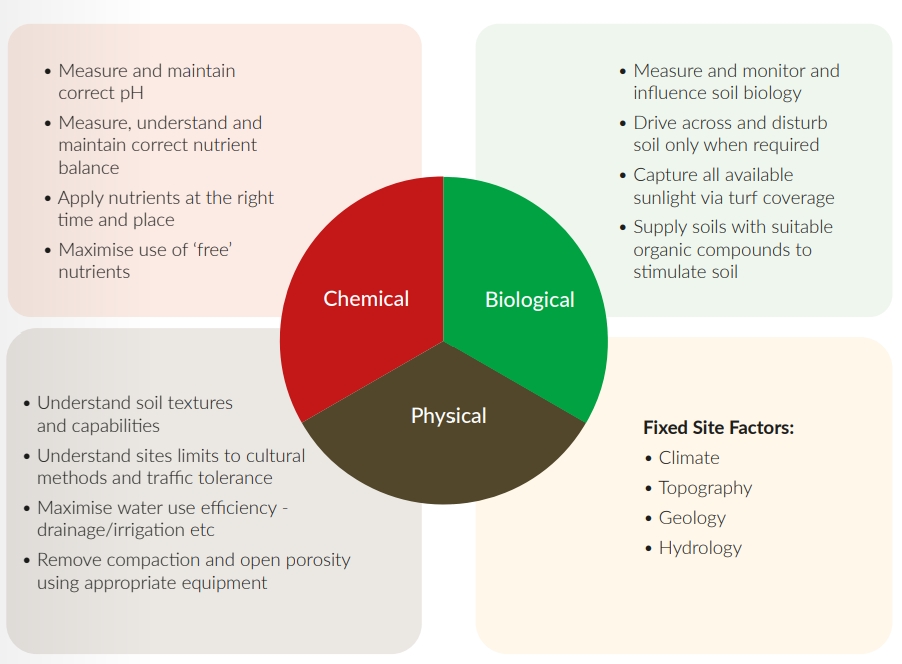
Regular soil testing and inspections are important in helping to adapt methodologies in-line with any reported changes, whilst maintaining soil health quality. Although fixed factors such as climate, topography, geology, and hydrology are beyond a turf managers influence, numerous chemical, physical and biological parameters can be practically influenced and managed on site.
Agrovista’s comprehensive soil health report is designed to help turf managers focus on all aspects of soil health and provide the chemical, physical and biological solutions necessary to manage soils for the benefit of long-term sustainability and performance standards. Some of the key focus areas are demonstrated in the following diagram.
Chemical
Measuring and managing pH is fundamental to soil health and turf quality as it significantly influences both nutrient availability and soil biology. From a broad-spectrum soil analysis, it is possible to discover the best product and strategy to improve and maintain pH for a particular soil type. Measuring full soil nutrient status enables accurate fertiliser planning for maximum efficacy and cost effectiveness. It provides all the information needed to manage nutrient interactions in the soil and maximise nutrient availability. Making more natural or ‘free’ nutrients in the soil available to plants is becoming increasingly important as we strive towards producing better quality turf with fewer inputs. The use of appropriate biostimulants can assist with improving plant responses to nutrient applications. Improving soil structure and soil biology will also help maximise the availability and uptake of natural nutrients contained in the soil.
Physical
An understanding of how the soil was formed, what its natural texture and structure should be and what its natural limitations are is again key to maximising turf quality. Improving water use efficiency through suitable soil structure, adequate drainage systems, aeration and, where necessary, irrigation is the backbone to maximising turf quality. Soil compaction is one of the most common and most serious ailments within any sports turf surface.
The rigours of play combined with the necessity of machinery maintenance combine to force together particles within a soil. Clay and silty soils containing a high proportion of fine particles are particularly prone to compaction however, all soils can be compacted. The compaction in a soil tends to form in layers, or ‘pans’ between which less compacted zones are present, each layer presents a barrier to healthy plant growth, balanced soil biology and water percolation.
The highest layer tends to be caused by contact pressure from people and equipment pressing on the surface. Deeper layers are also potentially caused by contact pressure but are also created by load (weight) from maintenance equipment. Operations such as cultivation or even turf aeration consistently repeated at the same depth are also contributory factors for the cause of deeper compacted zones.
Vertical Compaction Relief
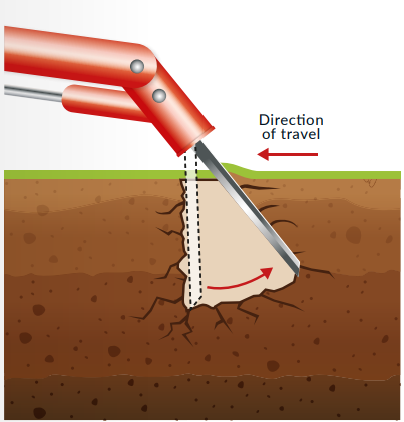
Vertical compaction relief is achieved by a lever action on the soil, similar to the heave action of a garden fork inserted vertically into the ground and pulled back towards the user. Machines designed to relieve compaction in this way have arms which can be adjusted to alter the degree of heave and various shapes and sizes of tines can be fitted to vary the effect on the soil. The machines are driven by a power take off (PTO) when mounted to the three point linkage of a tractor
Rotary Linear Compaction Relief
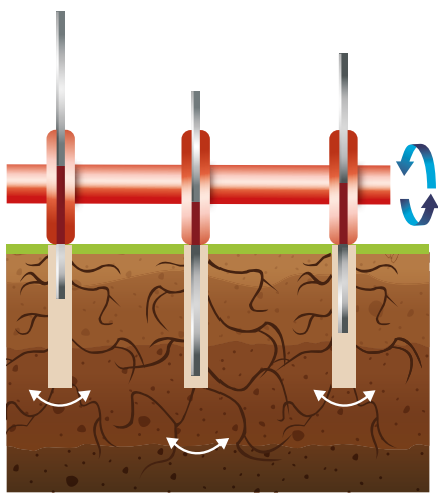
A rotary linear aerator decompacts the soil using a set of rotating steel blades. The blades are arranged on a drive shaft in such a way that when they pass through the soil, they create a wave action which shatters compacted areas and opens up the sub soil. Machines are available from several manufacturers and as with a vertical aerator they are driven by a PTO and mounted to a tractors three-point linkage. Additionally, long-term drainage systems can be installed. Whilst this can be very expensive; it must be remembered that it is a long-term investment, and most well maintained drainage systems should have a useful life of at least 20 years, and some will still function well several decades longer.
Biological
There is a school of thought that if soil chemistry and physics are in good order, then soil biology will start to look after itself. However, there is a lot that can be done to improve soil biology.
Whilst it is very difficult to measure such a complex element in the soil, Agrovista’s comprehensive soil health analysis will provide an indication of both soil micro and macrobiology. This, combined with other parameters in soil such as carbon to nitrogen ratio, enables turf managers to start to create ways of maintaining, balancing or improving the soil biology with different management strategies, applications of different biostimulants or soil amendments. Reducing unnecessary traffic, particularly in wet conditions, can have a huge impact on soil biology.
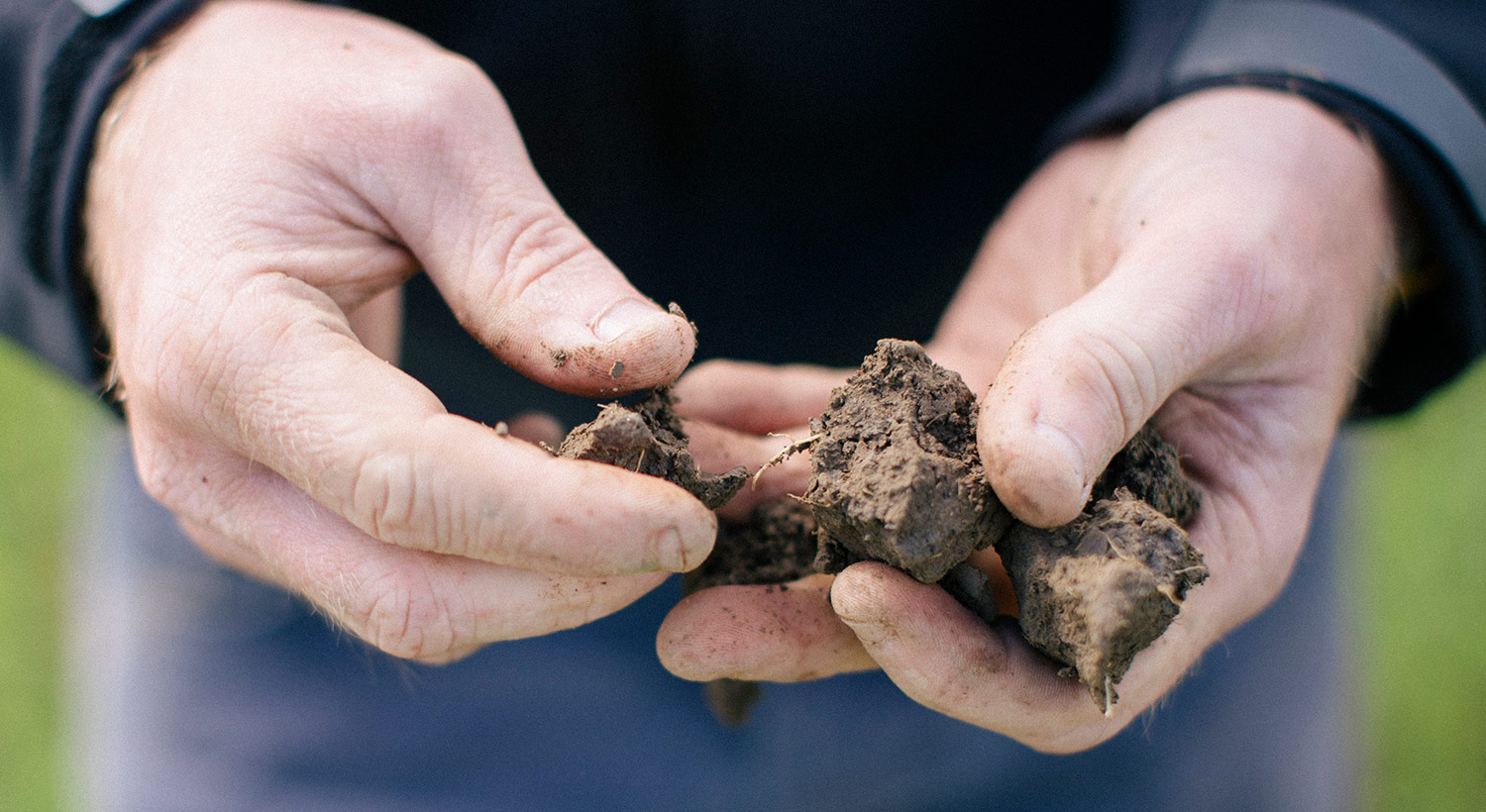
Creating a healthy soil is much like providing a hotel for soil biology. Every time a machine is driven across that soil, the hotel is potentially squashed. There are now opportunities to add biology to the soil by applying specific soil fungi and bacteria, often termed ‘bugs in jugs’. Some of these products are intended to reduce diseases by priming plant defensive responses to them or by outcompeting for space and food in the rootzone. Other biological products are intended to positively influence plant growth and quality through mechanisms such as improved nutrient availability and uptake.
Utilising the comprehensive Agrovista soil health analysis, all the above issues can be identified and quantified and practical solutions provided to build good quality soils with appropriate structure, chemistry and biology for excellent performing turf surfaces.