Understanding fungicides
Learn more about fungicide mode of action, application timings and turf disease host, environment and pathogen.

Course content
Mode of action
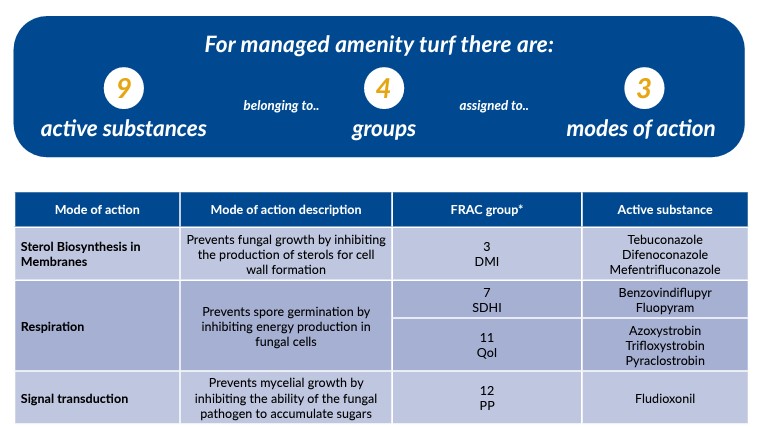
When using fungicides as part of an integrated approach to the control of fungal pathogens on turfgrass it is important to time applications to achieve maximum effectiveness and to rotate active substances to minimise the likelihood of resistance developing.
Disease triangle
Turf surfaces can be susceptible to a variety of fungal pathogens because they are highly managed environments which can undergo considerable stresses. The disease triangle illustrates that disease is the result of three interacting factors: the pathogen, the host, and the environment.
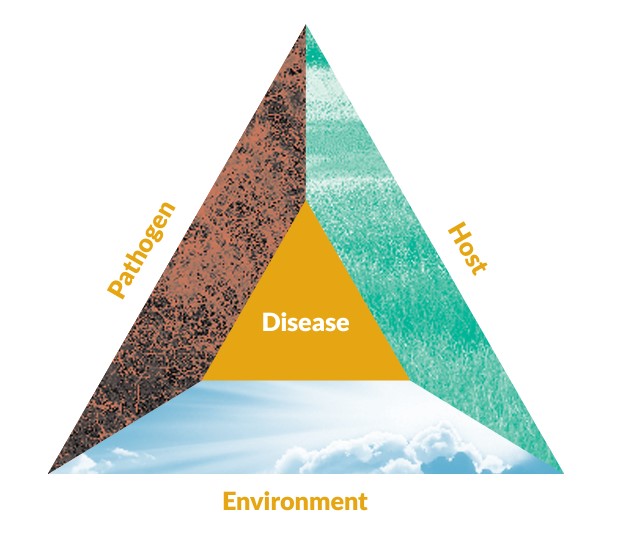
Pathogens may be present but without a suitable host or environmental conditions they will not develop to create disease within the plant. An integrated approach to turfgrass management can be used to reduce the risk of diseases developing. This can include actions to remove the host by using species or cultivars that are not susceptible to particular diseases. The environment can also be manipulated, for example by ensuring that the turf has appropriate amounts of air circulation, water, and nutrition to encourage healthy growth.
When turf diseases do develop, or when the environmental conditions mean that they are likely to develop, conventional fungicides remain an important part of an integrated approach to disease management on turf surfaces. An understanding of the risk periods for different fungal pathogens and of the environmental conditions that favour them can help turf managers to anticipate when treatment might be required.
Fungicide application timing
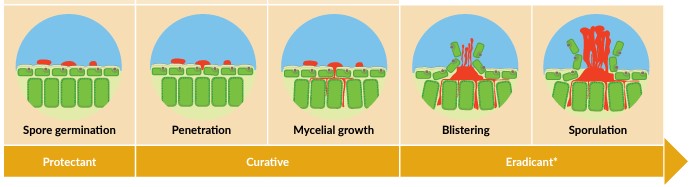
Currently authorised fungicides all reduce disease most effectively when they are applied either before disease development or in the very early stages of disease development. They can be split into two categories:
Protective fungicides
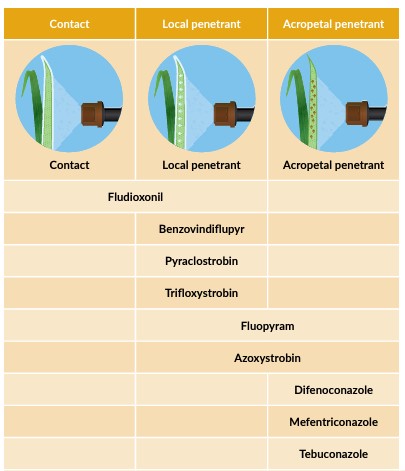
Protective fungicides need to be applied before or during spore germination to prevent the penetration of fungal hyphae into plant tissues before the pathogen becomes established. Contact fungicides are not absorbed into the plant, whilst local penetrants are held on, or within, the waxy outer surface of the leaf. They may translocate to the other surface of the leaf but will not move systemically around the plant.
Curative fungicides
Curative fungicides can be applied at the early stages of active infection and will move through the plant to control the development of fungal hyphae. Local penetrants may have some curative ability directly below the site of application as the active substance moves from one leaf surface to the other. However, acropetal penetrants will be translocated upwards through the plant in the xylem. This means that they can reach plant tissues that have not been sprayed.