Wildflowers
Learn how to plan, sow and manage wildflowers.

Course content
Wildflower planning

Meadow type
First consider which type of meadow you would like to create depending on the attributes of your site and your objectives:
Wildflower meadows
• Mimic existing semi-natural habitats
• Can be established on poor soils
• Often contain grasses
• Contain only native grasses and wildflowers
Ornamental flowering meadows
• Have a long flowering period
• Can be established on sites with higher nutrient levels
• Does not usually contain grasses
• Can contain non-native or cultivated ornamental plants
Soil nutrient levels
It is important to understand the soil properties if your intention is to create a wildflower meadow. Ornamental flowering meadow mixtures can tolerate most soil types but prefer soils which can retain some moisture. Wildflower meadows containing annual wildflower species are also able to cope with slightly higher nutrient levels in the soil. Wildflower meadows containing perennial wildflower species require soils with low nutrient levels as these favour less vigorous plants and enable a greater species diversity to develop. Low levels of nitrogen and phosphorus in the soil are of particular importance for creating species diverse wildflower meadows.
Nitrogen
The amount of nitrogen in the soil is difficult to measure accurately because nitrogen is a particularly mobile nutrient with the plant available forms, nitrate (NO3-) and ammonium (NH4+) fluctuating considerably over short periods of time. Nitrogen levels are therefore often estimated based on known contributing factors such as soil texture and previous site use. As a guide, silt, loam and clay soils are more likely to retain nitrogen over time than sandy soils. In addition, a recent history of cultivation or fertilisation of the site is likely to result in high nitrogen levels which may need to be reduced before a species rich wildflower meadow can be established successfully.
Phosphorus
High levels of soil phosphorus promote growth of competitive grass species at the expense of wildflowers. Existing semi-natural wildflower meadows that are flower rich tend to have low soil phosphorus levels (soil index 1-2). When trying to establish a wildflower meadow at a new site, it is preferable if soil phosphorus levels are below soil index 2 (16 mg/l).
Soil moisture
It is always important that soils can supply sufficient moisture to support plant growth. This can be achieved on a variety of soil types; however, specific mixes are more suitable for soils or sites which are prone to being wet. For example, soils with a high clay content, wetland sites or pond edge sites.
Light
Most wildflower meadows and ornamental flowering meadows are located in areas which receive a good amount of sunlight. If a site is particularly shady, a specialist seed mix designed for shady conditions will be required containing species which are adapted to low light levels.
Wildflower seed sowing

Timing
In general, ornamental flowering meadow seeds are best sown in the spring. Annual wildflower meadow
seeds can be sown in the autumn and perennial wildflower meadow seeds in late summer/autumn. Both types of wildflower meadow seeds can also be sown in the spring if conditions are unsuitable in the autumn, for example, if waterlogged conditions over the winter are expected.
Sowing
Use the correct sowing rate for the seed mix and sow seeds evenly either by hand or using a seed spreader or drill. Because sowing rates for wildflower seed are low, it is usually helpful to mix the seed with a carrier material such as slightly damp sand. Ensure good seed to soil contact by pressing the seeds into the soil using a roller or the back of a rake or by irrigating with a fine spray after sowing. Keep the soil surface moist but not overly wet until the seeds have germinated and established. When supplementary irrigation is required be sure to irrigate slowly and gently to avoid disturbing the seeds.
Wildflower management & aftercare

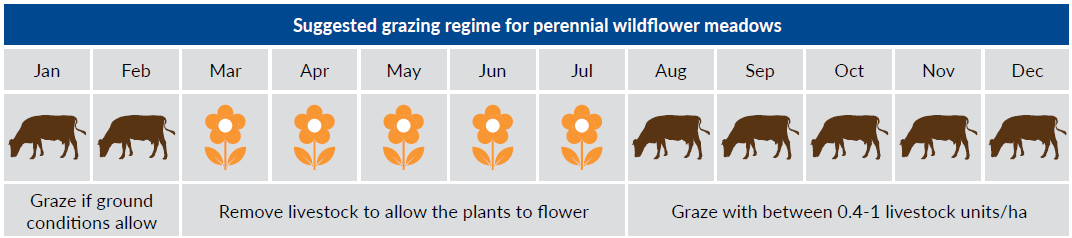
Perennial wildflower meadows: Livestock grazing
Grazing with livestock is an effective method of managing perennial wildflower meadows and grasslands because it creates uneven growth and distribution of species which leads to habitat niches. Grazing is also a good option in areas where it is difficult to utilise machinery, perhaps because it is too wet or because the ground is too rough.
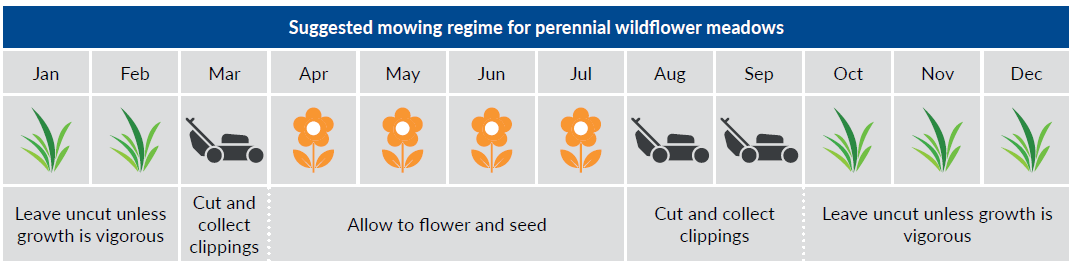
Perennial wildflower meadows: Mowing
Mowing and removing the clippings can be used to replicate the process of hay cutting and grazing. It is important to remove clippings to avoid nutrients being returned to the soil. Soils for wildflowers are usually low in nutrients to encourage species diversity.
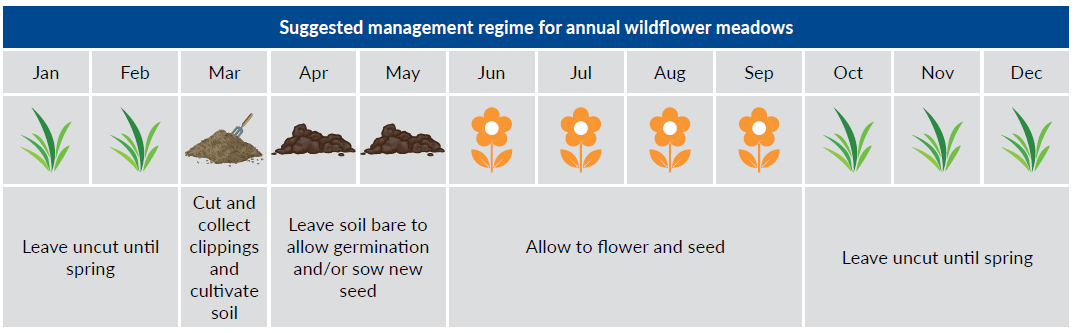
Annual wildflower meadows
Cornfield annuals need disturbed ground to stimulate germination of fallen seed. After flowering leave plants long enough for seeds to drop. Preferably wait until the spring before cultivating the ground to avoid leaving bare soil over winter. Cultivating the soil may stimulate growth of fallen seed but it may be necessary to supplement with further sowing in subsequent years.